How to pay in China as a foreigner.
You've heard China is completely cashless and foreign cards don't work. Some of that is true, and it's not the whole story. You need four things: Alipay, WeChat Pay, at least two bank cards, and a little cash.
Before you leave home
- Verify Alipay and WeChat Pay with your passport.
- Link at least two cards from different banks. When one is declined, you switch in the same app.
- Keep the phone number your bank sends codes to working while you're in China.
- Bring a physical card that works internationally, ideally contactless.
Where each method works
| Where | What works | Notes |
|---|---|---|
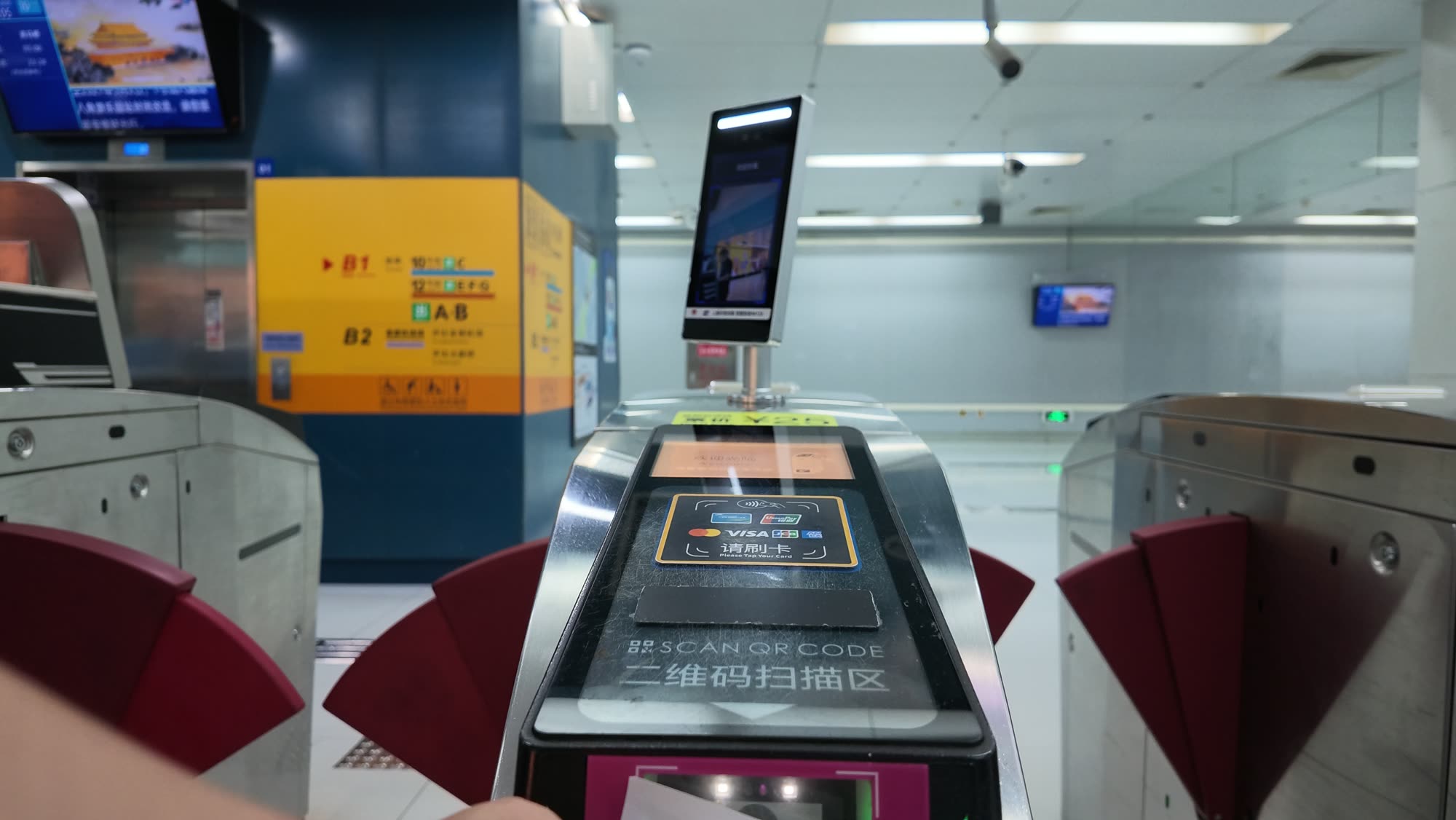
| Subway and Airport Express | Tap an international contactless card at the gate: Visa, Mastercard, UnionPay, JCB, American Express | Same card in and out. No app, no transit card needed. The most foreigner-friendly part of the system. |
| City buses | Transport code inside Alipay; cash accepted | Buses don't give change, so carry coins and small notes. |
| Taxis and DiDi | Order a DiDi inside Alipay, or the DiDi app with your home number and an international card; taxis take cash | For a private car you pay in the app. |
| Convenience stores, supermarkets, cafés, restaurants with a counter | Show your pay code in Alipay or WeChat; the cashier scans you | The simplest and usually the most reliable way. |
| Street stalls, market stands, tiny shops | You scan their printed QR code and type the amount | If it's the owner's personal transfer code, a foreign card won't work. The screen will say your card isn't supported. Pay cash; it's a small amount anyway. |
| Hotels, malls, nicer restaurants | International cards accepted directly | For bigger purchases this is often cheaper than paying through the apps. |
Scan-to-order in restaurants
Many restaurants in Beijing have no paper menu. You sit down and scan a QR code on the table. What opens is usually the restaurant's own mini program inside WeChat or Alipay. It may ask you to log in, share a phone number, join as a member, and it may be in Chinese. If it wants a Chinese number or just won't work for you, ask the server: "Could you help me order?" Most places will take your order at the table, and some still have a paper menu. You pay at the counter afterwards, with Alipay, WeChat, cash, or a card where they take international cards.
Fees on foreign cards
- Paying through Alipay or WeChat with a foreign card: 200 yuan or less per transaction, no fee. Above 200, about 3%. WeChat sometimes waives it for new users for a while. The payment screen shows the exact amount.
- Your own bank may add a foreign transaction fee or a currency conversion fee on top.
- For larger purchases at hotels, malls and nicer restaurants, paying with the physical card directly is often easier and cheaper.
When a payment fails
Don't keep tapping. First check whether it says failed or just processing, and look in your bank app to see whether you were actually charged. If it really failed, try these in order:
- Check your connection and turn off your VPN for a moment.
- Switch to another card in the same app.
- Switch from Alipay to WeChat, or the other way around.
- If the shop has a scanner, show your own pay code and let them scan you instead.
- If they have a card machine that takes international cards, use your physical card.
- Pay cash.
If the message is about your account being limited or needing more verification rather than a normal decline, that's a security check on the account. Pay this one with any of the methods above, then follow up with Alipay, WeChat or your bank afterwards, or it may keep happening.
Cash: how much, and where to get it
A lot of people think cash is useless in China. It's actually one of the most reliable ways to pay, and almost every shop takes it. You don't need much: 100 to 200 yuan per person is enough to start. Carry small notes, twenties, tens and fives, so getting change is easy. Buying something small at a convenience store is the easiest way to break a hundred.
At Capital Airport Terminal 3, there's an ATM right behind the Payment Service counter at Exit B, and most international cards work. There's no currency exchange on the arrivals floor; the exchange counter is one floor down on B1.
| Option | What it costs | Example |
|---|---|---|
| ATM | Your bank's withdrawal fee, typically $3 to $5, plus a rate markup of about 1% to 2% | On $100, you lose about 4% to 7% |
| Airport exchange counter (B1) | Rate below mid-market plus a fixed fee per transaction | On 1 September 2026: $100 bought ¥634, minus a ¥38 fee, ¥596 in hand. Mid-market that day was about ¥671. About 11% lost. |
Since you don't need much cash, the difference is small in absolute terms. Use whichever is easier and don't spend your first hour on it.
Help at the airport
If Alipay or WeChat still isn't set up when you land, there's a Payment Service counter directly across from Exit B, next to China Mobile. Tell them you need to set up Alipay and WeChat Pay and they'll walk you through it. They also hand out a booklet called Guide to Payment in Beijing. I scanned it page by page; the free PDF is here.
Fees and acceptance checked July 2026; airport counter, ATM and exchange figures checked 1 September 2026. These change. Check the payment screen and your bank before you rely on any number here.